Have you ever heard someone in your family ask, “Where did you put that?” even though the item is sitting somewhere inside the house? When storage information exists only in one person’s memory, finding everyday or seasonal belongings can quickly become frustrating.
A well-organized home should make it easy for everyone to locate what they need. Instead of relying on memory, families can create a simple storage system that clearly identifies what is inside each box, bin, or container. With consistent labels and a searchable inventory system, everyone can find stored belongings without opening multiple containers or asking for help.
Why Family Storage Becomes Difficult to Manage
As families accumulate clothes, decorations, toys, documents, tools, and seasonal belongings, storage areas can become crowded. Items are often placed wherever there is available space rather than according to a consistent system.
The problem becomes even more noticeable when one family member handles most of the organizing. They may remember exactly where holiday decorations or winter clothing were placed, while everyone else has no idea.
This can lead to unnecessary searching, duplicated purchases, and frustration. A clear labeling system gives every household member a reliable way to understand what is stored and where it belongs.
Give Every Storage Box a Clear Purpose
One of the easiest ways to improve household organization is to assign a specific category to each container. Instead of mixing unrelated belongings, group similar items together.
For example, one container can hold winter accessories, another can store children’s clothing, and another can contain holiday decorations. The label should provide enough information to identify the contents without requiring anyone to open the box.
You can also organize containers by room, family member, season, or frequency of use. The best system is one that everyone in the household can understand and follow.
How to Organize a Clothes Storage Box
Knowing how to organize a clothes storage box can make seasonal clothing changes much easier. Start by separating clothes according to type, season, or person. Avoid putting summer and winter clothing into the same container unless there is a specific reason to do so.
Before storing clothing, make sure it is clean and completely dry. Fold items neatly and avoid overfilling the container because tightly packed clothes can be difficult to remove later.
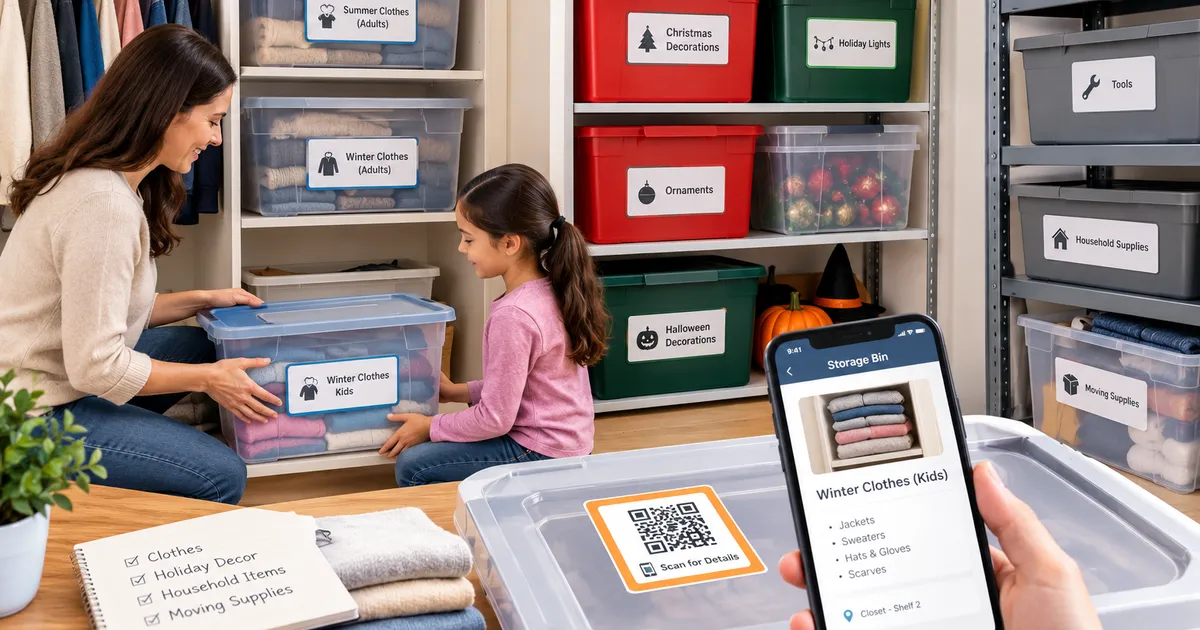
Use a clear label such as “Winter Clothes – Kids” or “Summer Clothes – Guest Room.” If you have several similar containers, add more specific information to help family members distinguish between them.
A digital record can make this system even more useful. Instead of depending entirely on the physical label, you can keep additional information connected to each container, such as the exact contents or storage location.
Make Holiday Storage Bins Easy to Identify
Holiday decorations are some of the most commonly forgotten storage items. Families may have several similar containers containing ornaments, lights, wrapping supplies, decorations, and outdoor items.
Using dedicated holiday storage bins for different categories can simplify the process. For example, you might have separate containers for Christmas decorations, Halloween supplies, birthday decorations, or general seasonal items.
Rather than writing only “Holiday,” use a detailed description. “Christmas Tree Decorations” is much more useful than a generic label because it immediately tells everyone what to expect.
You can also create a simple inventory for each container. When the holiday season arrives, family members can identify the right container without searching through the entire storage area.
Create a Storage Map Everyone Can Understand
Labels are helpful, but a larger storage system can make organization even easier. Think of your home storage areas as a simple map.
For example, you could organize one section of the garage for seasonal belongings, another for household tools, and another for moving or travel supplies. Closets, basements, attics, and storage rooms can follow the same approach.
Give each storage area a logical purpose and keep similar categories together. When everyone follows the same system, family members are less likely to move items randomly or create new piles.
Use Digital Information Alongside Physical Labels
Traditional labels tell you what a container holds, but digital organization can provide much more information.
A digital inventory can include photographs, descriptions, keywords, and other details that are difficult to fit on a physical sticker. This is especially useful when containers look nearly identical.
Imagine looking for a specific kitchen appliance stored months ago. Instead of opening every box, you could check the digital record and identify the container associated with that item.
This approach can be particularly useful during decluttering before moving. When preparing for a move, families often have dozens of boxes spread across different rooms. Knowing what is inside each box makes packing, transportation, and unpacking much easier.
Teach Everyone the Same Organization System
A storage system only works when everyone understands it. Take a few minutes to explain how categories, labels, and storage locations work.
Children can learn to return their belongings to the correct containers, while adults can quickly identify household supplies without relying on one person’s memory.
Try to use simple and consistent naming. If one box says “Christmas,” another says “Xmas Decor,” and another says “December Stuff,” family members may become confused. Choose one naming style and use it consistently.
The goal is not to create a complicated system. It is to make finding and returning items easier for everyone.
Reduce Clutter While Improving Storage
Better labeling should not become an excuse to keep everything. While organizing containers, take the opportunity to decide whether each item is still useful.
During decluttering before moving, separate belongings into categories such as keep, donate, sell, recycle, or discard. There is little benefit in creating a perfect inventory for things your family no longer needs.
Once unnecessary items have been removed, organize the remaining belongings into clearly defined categories. A smaller collection of well-organized possessions is much easier to maintain.
Make Storage Smarter With Elephant Trax
If your family frequently struggles to remember where belongings are stored, a smart QR-based system can take organization a step further.
Elephant Trax allows you to connect physical QR labels with digital information through its app. Instead of relying only on a handwritten description, you can associate items and photos with a QR label and access the information by scanning it.
This can be especially useful for storage boxes, seasonal belongings, moving boxes, household inventory, and items stored in different areas of the home.
For families that want a more organized way to identify and track stored belongings, consider exploring Elephant Trax Shop QR Labels. A simple scan can help turn ordinary storage containers into a more searchable and manageable home inventory system.
Final Thoughts
When family members constantly ask where things are stored, the problem is usually not the amount of storage—it is the lack of a shared system.
Clear categories, consistent labels, organized containers, and digital inventory information can make belongings easier for everyone to find. Whether you are organizing clothes, seasonal decorations, household supplies, or preparing for a move, the right system can save time and reduce everyday frustration.
A home becomes much easier to manage when everyone knows not only where things belong, but also how to find them when they are needed.