Organizing your belongings into boxes and bins can make a home feel cleaner and more manageable. But simply putting a label on each container does not always solve the problem. As the number of stored items grows, basic labels can make it difficult to know exactly what is inside a box or where a particular item has been placed.
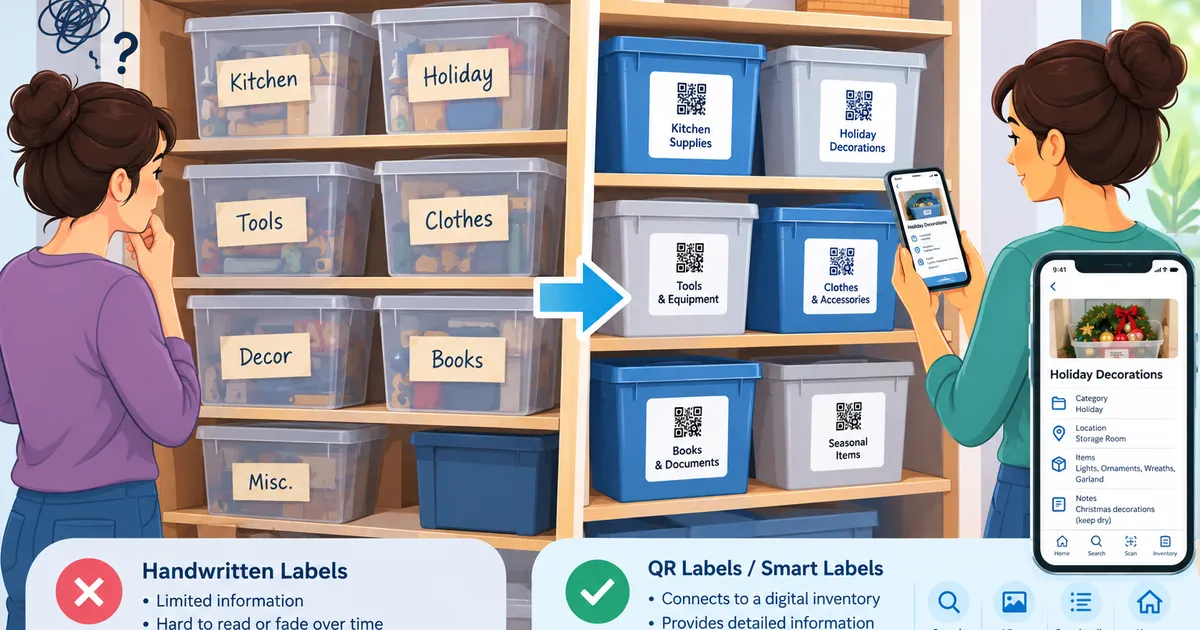
Handwritten labels are inexpensive, familiar, and easy to create. However, they often provide only limited information. A label saying “Kitchen,” “Clothes,” or “Holiday” may identify a general category, but it does not necessarily tell you which specific items are inside.
This can turn an organized storage area into another place where you spend time searching. Fortunately, modern labeling methods can make it easier to keep track of stored belongings.
The Limitations of Handwritten Labels
The main problem with handwritten labels is that they usually provide only a small amount of information. When packing a container, you may remember exactly what is inside. Months later, however, that memory may not be as clear.
For example, a box labeled “Winter” could contain coats, scarves, gloves, boots, blankets, or decorations. If you need only one pair of gloves, you may still have to open several containers to find them.
Another issue is that handwritten labels can become outdated. If you move items between containers, add new belongings, or remove something, the original label may no longer accurately describe the contents.
This means your storage system can gradually lose its usefulness even if the containers remain neatly arranged.
Why More Information Matters
Good organization is not only about putting things away. It is also about being able to find those things later.
Imagine having twenty storage bins in a garage. Each bin has a handwritten label such as “Tools,” “Kids,” “Office,” or “Miscellaneous.” At first glance, this may look organized. But when you need one particular item, the labels may not provide enough information to identify the correct container.
A more useful system can include details such as item names, photographs, categories, quantities, notes, and storage locations.
The more useful information you have available, the less time you need to spend searching through containers.
Handwritten Labels Can Become Difficult to Read
Another challenge is readability. Handwriting varies from person to person, and labels can become difficult to understand when written quickly.
Ink can also fade, labels can become dirty, and adhesive labels can peel away from containers over time. Storage areas such as garages, basements, attics, and sheds may expose labels to dust, moisture, temperature changes, and frequent handling.
When a label becomes difficult to read, identifying the contents of the container becomes even harder.
Smart Labels Provide More Than a Name
Modern smart labels offer a different approach to organizing belongings. Instead of relying only on a few handwritten words, a smart label can connect a physical container to additional digital information.
This is particularly useful when you have a large number of boxes or containers. A label can identify the container while a digital inventory provides more detailed information about its contents.
With qr labels, for example, a scannable code can be placed directly on a storage container. Scanning the code with a compatible phone or system can provide access to information associated with that particular box or bin.
This creates a connection between the physical storage space and a digital record.
QR Labels Can Make Stored Items Easier to Find
One of the biggest advantages of QR-based organization is the ability to connect individual containers with detailed inventory information.
Instead of writing “Christmas” on a box and hoping that is enough, you can maintain a digital record of the items inside. You could potentially record decorations, lights, ornaments, wrapping supplies, and other seasonal belongings.
When you need something later, you can search the inventory instead of opening multiple boxes.
This approach can be especially helpful for people who have large collections of seasonal decorations, clothing, household supplies, children’s belongings, tools, or moving boxes.
Storage Bins Need a Consistent Labeling System
Using storage bins is a popular way to keep homes organized. They protect belongings, make stacking easier, and help maximize available space. However, having many bins can create a new challenge: identifying what each container contains.
A consistent labeling system can solve part of this problem.
Each bin can have its own identifier and corresponding digital record. Instead of depending on a broad handwritten description, you can create a more detailed system that makes each container easier to recognize.
This becomes increasingly valuable when storage areas contain dozens of similar-looking containers.
Make Your Home Inventory Easier to Manage
A home inventory can help you understand what you own and where it is stored. However, maintaining one manually can become time-consuming.
A digital approach can make the process more practical. Instead of creating a long list that is disconnected from your physical containers, items can be associated with specific boxes, bins, rooms, or storage areas.
For example, you might record a power drill, extension cords, and screwdrivers as items stored in a particular garage bin. If you later need the drill, you can identify its associated container rather than searching every bin.
This turns storage from a collection of containers into an organized system.
The Role of a Home Organizer
A professional home organizer often focuses on creating systems that are easy to maintain, not simply making a room look tidy.
That same principle can be applied to digital storage organization. A good labeling system should answer two important questions: “What is here?” and “Where can I find it?”
Traditional labels can help answer the first question at a very basic level, but combining physical labels with digital information can provide much more detail.
The goal is not to eliminate simple labels completely. Instead, it is to use a labeling method that matches the complexity of your storage needs.
When Should You Upgrade Your Labeling System?
Not every storage container needs a complicated system. If you have a few boxes in a closet, simple labels may be perfectly adequate.
However, upgrading your labeling system can make sense when:
Your storage area contains many similar containers.
You frequently forget where specific items are stored.
You regularly move belongings between boxes.
You manage seasonal items that remain stored for long periods.
You have a garage, attic, basement, or storage unit with numerous containers.
You spend too much time opening boxes to find individual items.
In these situations, a digital labeling approach can reduce unnecessary searching and make your storage system easier to maintain.
Build a Storage System That Works for You
The best organization system is one that remains useful after the initial cleanup. A room may look perfectly organized today, but if you cannot find anything three months later, the system has not solved the real problem.
Start by identifying the areas where searching is most frustrating. Group similar belongings together, give each container a clear identity, and record useful information about its contents.
You can then use qr labels or other smart labels to connect physical containers with digital records. This creates an organization system that can grow as your belongings and storage needs change.
Conclusion
Handwritten labels are a simple starting point for organizing boxes and bins, but they may not provide enough information when storage becomes more complex. Broad descriptions can leave you guessing about what is actually inside a container, while faded or outdated labels can make searching even more difficult.
Modern labeling solutions offer a way to go beyond basic descriptions. By combining physical containers with digital information, smart labels and qr labels can make stored belongings easier to identify, track, and find.
Whether you are organizing a small closet or an entire garage, the goal is the same: create a storage system that saves time instead of creating more work. A smarter approach to labeling can help turn your storage space into an organized system that is easier to manage every day.