Anyone who has ever dug through a stack of taped-up boxes looking for a single winter sweater knows the frustration of disorganized storage. Whether you’re storing seasonal decorations, off-season clothing, tools, or sentimental keepsakes, the biggest challenge isn’t the storing itself — it’s finding what you need later without tearing through every container. Fortunately, with the right approach and tools, you can build a system that lets you locate any item in seconds, not hours.
Why Traditional Storage Fails
Most people label boxes with a marker and a vague word like “misc” or “holiday stuff.” This works fine for the first few weeks, but as boxes stack up, memory fades, and labels become meaningless. You end up opening box after box, creating a bigger mess than you started with. The real problem is that a handwritten label only tells you a category — it doesn’t tell you exactly what’s inside, and it definitely doesn’t help you search across dozens of boxes at once.
This is where a smarter, tech-enabled approach makes all the difference.
The Power of a QR Code Storage System
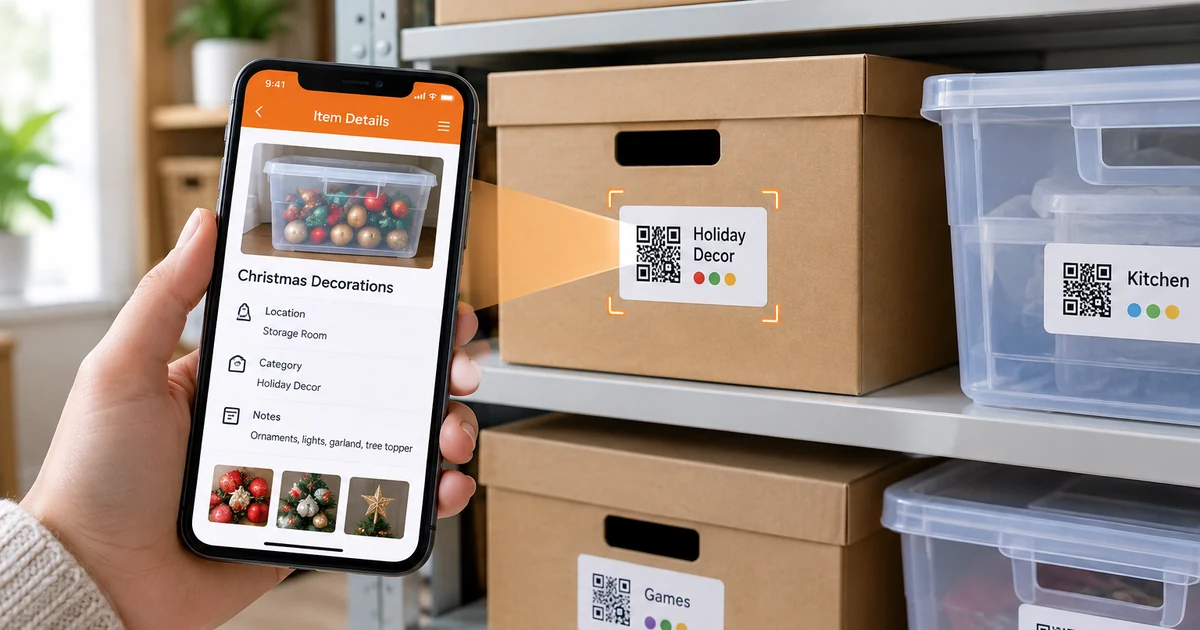
A QR code storage system solves the guessing game entirely. Instead of relying on your memory or a brief label, you assign a unique QR code sticker to each box or bin. When you pack the container, you take a quick inventory — either with a notes app, a spreadsheet, or a dedicated storage app — and link that inventory to the QR code.
Later, when you need to find something, you simply scan the codes with your phone’s camera instead of opening every lid. Within seconds, you’ll see a full list of what’s inside that particular box. Some apps even let you search across your entire inventory, showing you exactly which box contains your holiday lights or your child’s old artwork, without you touching a single container.
Benefits of Using QR Codes for Storage
- Instant identification — scan and know immediately what’s inside
- Searchable inventory — find an item across multiple boxes with one search
- No more repacking mess — you only open the box you actually need
- Great for shared spaces — family members or roommates can scan and check contents themselves
- Ideal for storage units — since you can’t always bring every box home to check
Setting this up takes a bit of upfront effort, but the time saved later is enormous, especially for people with garages, attics, basements, or off-site storage units packed with dozens of similar-looking boxes.
Pairing QR Codes with the Right Storage Organizer Bins
A QR code system works best when paired with quality storage organizer bins rather than random cardboard boxes. Bins offer several advantages that make your system more durable and effective long-term.
First, clear plastic storage organizer bins let you visually confirm contents at a glance, which works as a nice backup to your QR code inventory. Second, uniform bins stack more securely and consistently, making it easier to organize shelves by category — for example, one shelf for kitchen items, another for seasonal décor, and another for documents. Third, bins with secure lids protect against dust, pests, and moisture far better than standard boxes, which is especially important for long-term storage.
When choosing organizer bins, look for:
- Stackable design with interlocking lids for stability
- Clear or semi-transparent material for visual confirmation
- Consistent sizing to maximize shelf and floor space
- Sturdy handles for easy transport
- A flat surface for applying your QR code label
By combining sturdy, uniform storage organizer bins with a scannable QR code storage system, you create a setup that’s both physically organized and digitally searchable.
Setting Up Your System Step by Step
- Gather your bins. Choose consistent, stackable storage organizer bins based on your available space.
- Sort and pack. Group similar items together rather than mixing categories.
- Generate QR codes. Use a free QR code generator or a dedicated inventory app to create a unique code for each bin.
- Attach labels. Print and stick the QR codes on a visible, flat side of each bin.
- Log contents. Record a quick list of what’s inside each bin, linked to its QR code.
- Store bins logically. Arrange them by category or frequency of use, keeping commonly needed bins accessible.
- Update as needed. Whenever you add or remove items, update the digital inventory so your records stay accurate.
Final Thoughts
Digging through box after box is a thing of the past once you adopt a QR code storage system paired with reliable storage organizer bins. This combination turns a chaotic garage or closet into an easily searchable inventory you can access from your phone. Instead of guessing, unpacking, and repacking, you’ll know exactly where everything is with a quick scan — saving time, reducing clutter stress, and keeping your belongings safer and better organized for the long run.